


My awesometastic friend Sabbath loaned me her nursing necklace about a week ago. Braden has been a very distractable little boy lately. When he does settle down to eat, he pinches and grabs and hits; no fun for mommy! So she let me use her necklace to see if that would help focus him. Worked beautifully! Today she took me to this cute cute cute little bead shop in Tacoma. Luff that place, wow they've got gorgeous stuff there. So I bought my supplies and we high-tailed it outta there.
Here's the basics of what I got and how I did it.
1 yard of leather cord
8 inches of thin wire
1 tiny metal loop
2 tiny metal (joiners/fasteners? Anyway it slips over the wire and you squish it and it holds it shut)
handful of assorted pretty beads
I pulled the cord through the tiny metal loop and made sure it was in the middle. Then, with both halves of the strings held together, I looped it around itself to make a knot in the middle of the cord around the metal loop leaving the ends free. Then I took my wire and started adding beads. I put my middle bead on first, then added from each end to make sure it was symmetrical. When I had put all my beads on, I slid the metal fasteners on the end of the wire, pulled the free end back through the fastener one more time (so the end formed a loop) and clamped it shut. Repeat on the other end. Lastly, I gently opened the metal loop that was on the end of my cord and slipped my wire loops through it. When tying the ends of the cord, remember to make it big enough to slip easily over your head. Complicated sounding right? It's not, I just suck at explaining things. So here's pics!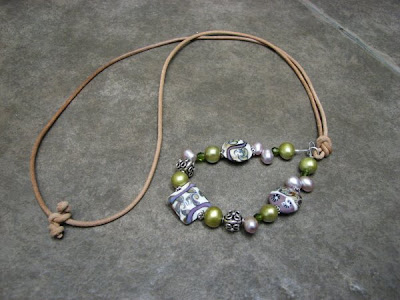


2008-07-16
Do-it-yourself Nursing Necklace


2008-03-24
Extended Breastfeeding
Overcoming the views of societal "norms" and what's best for your growing baby
A mom on my birth board asked this morning if it was ok to give her 18 month old bottles of her breastmilk. She was concerned about the "effects of breastmilk on toddler's bowels". It seemed quite strange to me that someone could not know that human milk is the best milk for human babies regardless of age. Yes, an 18 month old is still very much a baby. I went searching for a link to provide her showing that major world health organizations recommend breastfeeding until at least two years of age, and that the benefits last well beyond that. The UNICEF link states
Optimal breastfeeding practices include exclusive breastfeeding (breastmilk with no other foods or liquids) for the first six months of life, followed by breastmilk and complementary foods (solid or semi-solid foods) from about six months of age on, and continued breastfeeding for up to at least two years of age while receiving complementary foods."At least two years of age" That's a 24 month minimum that a child should be receiving mother's milk.
When I hear about doctors telling moms to wean so the baby will eat more solid food, I always want to ask them (the docs) what foods they had in mind as being nutritionally and immunologically superior to breast milk -- I mean, are we talking about hot-dogs here?
The benefits of nursing a toddler are many. Nursing toddlers have been shown to have fewer allergies, are sick less often, be better socially adjusted, and are smarter. Breastmilk is far superior to cows milk nutritionally for babies of this age as well. In the second year (12-23 months) 448ml (about 15oz) of breastmilk provides:
- 29% of energy requirements
- 43% of protein requirements
- 36% of calcium requirements
- 75% of vitamin A requirements
- 76% of folate requirements
- 94% of vitamin B12 requirements
- 60% of vitamin C requirements
Here is an article you may find interesting. It is by Katherine Dettwyler, PhD, Professor of Anthropology at Texas A&M. She studied our closest primate relatives to form a conclusions on when the "natural" age for humans to wean would be. According to her research, 2.5 to 7 years would be optimal time for us to wean.
And as always Kellymom has some great information for us: http://www.kellymom.com/bf/bfextended/ebf-links.html
2008-03-18
Breastfeeding vs Formula
I'll say up front that I am a lactivist (breastfeeding activist). This does not mean that I condemn formula feeding mothers, it just means that I 100% believe that breastmilk is far superior to formula, and I want that fact acknowledged. If people don't continue to promote breastfeeding, the formula companies advertising dollars will mean another generation raised on artificial foods and that's frightening. Babies who are fed formula are at much higher risk for an assortment of ailments including allergies, cancer, diabetes, and infections.
Pediatricians spend much time frightening parents with something like a 1 in 100,000 combined risk from vaccine-preventable diseases when parents question the utility and safety of vaccines. “Would you want to risk the life of your child?” they demand. Yet these very same professionals offer formula samples with the other hand – when the magnitude of health risks associated with the use of formula is 500 times greater.
I have heard the phrase over and over and over again that formula is "just as good" "just as healthy an alternative". It is not! Here is an fantastic article summarizing Dr Linda Folden Palmer's research study "The deadly influence of formula in America". Well worth the read for anyone wanting detailed statistics fully cited and backed by research.
Based on the current U.S. infant death rate of 6.7 and an average breastfeeding rate of 50%, the American infant mortality rate would climb to 9.4 if all infants were formula-fed and would drop to 4.7 if all were breastfed.
The phrase "Breast is Best" has been thrown around liberally to the point no one really pays it much attention anymore. They pay lip service to breastfeeding, all the while still assuming that formula is a low risk alternative. Many parents are well aware of issues such as car seat safety and sleep positioning, but don't realize that breastfeeding is more than "just another neutral lifestyle decision". The AAP (Academy of American Pediatrics) puts its squarely into the same importance rating as those other measures.
Parenting is all about making choices and weighing risks and benefits. Many parents need to make the riskier choice of formula feeding in order to balance other factors that benefit the family. Yet some parents who have lost their children, possibly based on pediatric advice condoning or encouraging formula-feeding, would surely wish that they had been informed of the very real risks related to using formula.
Links:http://www.aap.org/breastfeeding/
Journal of the American Medical Association
http://www.kellymom.com/newman/risks_of_formula_08-02.html
2008-03-12
Beauty

A gorgeous art spread by Peter Gasser, showing the natural beauty of mothers, children and breastfeeding. Worth a look.
2008-02-16


